
After moving from California to Pennsylvania, arrange delivery access, confirm truck parking, and notify the landlord, HOA, or building manager about loading rules and elevator reservations. Match delivery with the lease, closing, or possession date, keep keys and approvals ready, and photograph access routes. Pennsylvania requires vehicle title and registration within 20 days and a driver’s license within 60 days of residency. If the home is unavailable, confirm storage terms and release instructions.
Practical takeaway: Confirm access, parking, and timing with all parties and document route and approvals.
First Things to Handle After a California to Pennsylvania Move

Confirm your Pennsylvania delivery details with MoveEast before the shipment leaves California. Provide the destination address, a reliable contact number, the planned delivery window, and any gate, loading-area, elevator, or other access instructions. Tell dispatch the lease start date, closing date, or other date when the home will become available.
If the property is in a managed building, condominium, or HOA, contact the property manager or association before delivery. Ask whether the moving crew must reserve a loading area, use a specific entrance, submit proof of insurance or other paperwork, follow designated delivery hours, or reserve an elevator. Requirements vary by property, so obtain instructions in writing and send them to MoveEast.
Check the truck’s approach and unloading location at the Pennsylvania address. Confirm where the driver can safely park and whether street or driveway restrictions, low branches, narrow turns, gates, construction, or seasonal conditions may affect access. If the truck cannot reach the home directly, ask MoveEast how the final transfer will be coordinated and document the agreed arrangement.
Schedule delivery for a date when the property is available. If access is delayed, contact dispatch promptly rather than asking the driver to wait without confirmation. Ask about storage or rescheduling options if the home will not be ready when the shipment arrives.
Before the delivery crew arrives, make sure someone authorized can meet them, provide entry instructions, and identify where furniture and cartons should go. Keep keys, building or HOA approvals, floor plans, and the property manager’s contact information available. Protect newly finished floors or shared areas per the property’s instructions.
During unloading, check the shipment against the inventory as items enter the home. Note visible damage, missing items, or access-related issues on the delivery paperwork before signing, and keep copies of the completed documents.
After the crew leaves, verify that essential rooms are accessible and that building doors, gates, elevators, and shared areas are left as required by the property. Additionally, ensure that you have reviewed the insurance options available to protect your belongings during the move.
Practical takeaway: Confirm access, document instructions in writing, and communicate promptly with dispatch if the property isn’t ready.
Pennsylvania License Title Registration and New Resident Deadlines
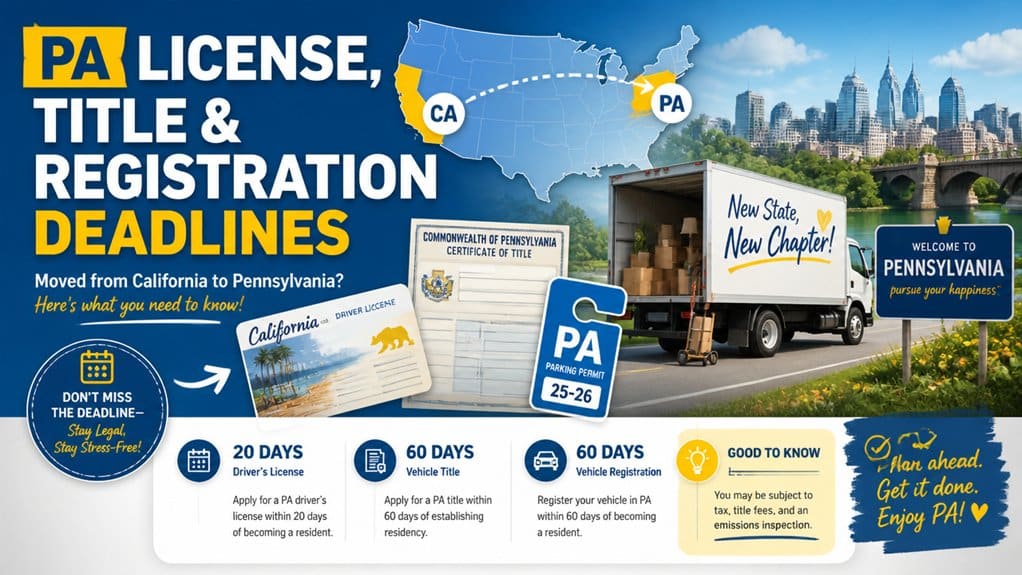
If you are moving from California to Pennsylvania, base your vehicle and driver’s-license deadlines on the date you establish Pennsylvania residency, not your moving-truck delivery date.
- Apply for a Pennsylvania title and vehicle registration within 20 days of establishing residency.
- If you hold an out-of-state non-commercial driver’s license, obtain a Pennsylvania driver’s license within 60 days of establishing residency.
- Confirm the current PennDOT process before scheduling appointments or submitting documents.
For the Pennsylvania title and registration process, you need valid Pennsylvania identification and proof of Pennsylvania insurance. An authorized PennDOT agent completes Form MV-1, Application for Certificate of Title.
You must surrender your California title as part of the Pennsylvania title process, so keep copies or other records of your title documents before submitting them.
Prepare your identification, insurance information, out-of-state title, and other ownership records before contacting the authorized agent. A lien, leased vehicle, or unusual title status may require additional documentation.
Keep the original title and related paperwork with you rather than placing them in your household shipment.
The Pennsylvania driver’s-license transfer is separate from vehicle title and registration. Review PennDOT’s current requirements and record your Pennsylvania residency date so you can track both deadlines.
For current instructions, check PennDOT’s pages for [new residents](https://www.pa.gov/agencies/dmv/resources/relocation/motor-vehicle-information-for-new-residents), [vehicle registration transfers](https://www.pa.gov/services/dmv/transfer-vehicle-registration-from-another-state), and [out-of-state driver’s-license transfers](https://www.pa.gov/services/dmv/transfer-a-drivers-license-from-another-state).
Plan Truck Parking and Delivery Access at Your Pennsylvania Address
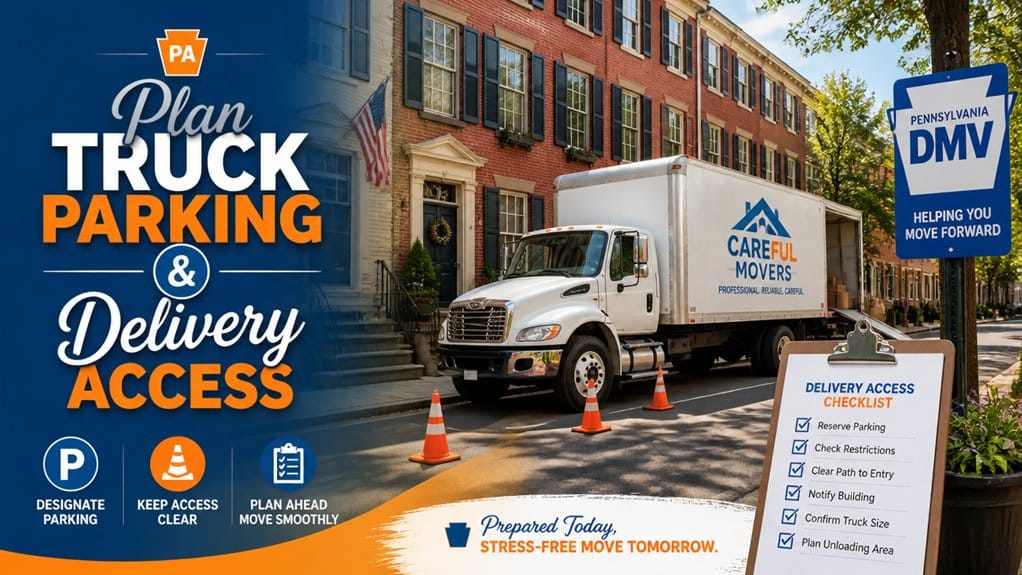
Before delivery, confirm where the MoveEast truck or an approved staging vehicle can legally and practically stop at your Pennsylvania address. Ask whether the driver will use the curb, a driveway, a nearby lot, or another staging point. Document any access limits that could affect the final approach.
Measure or estimate the distance from the planned truck or staging location to the entrance. Note whether the route includes:
- Narrow streets, tight turns, or limited curb space
- Low clearances, gated roads, or restricted truck access
- A long walk from the curb or staging area to the residence
- Stairs, steep grades, or uneven surfaces
- Gravel, grass, soft ground, or other difficult walking surfaces
- Building entrances, private roads, or property access limits
Send MoveEast clear photos of the approach, parking area, gates, turns, stairs, and path to the door. Include alternate staging locations if the closest access point may not be available on delivery day. Photos should show overhead obstructions and the full route from the proposed truck location to the residence.
Ask dispatch to review these conditions with the driver and delivery crew before scheduling the shipment. A long carry may be involved when goods must travel a significant distance between the truck or staging point and the residence. If the primary truck cannot reach the pickup or delivery entrance, a shuttle may be considered to transfer the shipment to a smaller vehicle.
Do not assume either service is required; ask MoveEast to review the documented conditions and applicable quote or service terms. Knowing the truck size options can help ensure the correct vehicle is scheduled for your move.
If parking or access may change by delivery day, identify the person who can confirm the location and coordinate with the driver. Provide updated instructions if a gate, alternate staging point, or route restriction affects the planned delivery approach.
Practical takeaway: Confirm and document specific parking and access details, send clear photos, and have a contact who can update the driver on delivery day.
Building HOA Elevator and Landlord Move In Rules
Before scheduling your California-to-Pennsylvania move-in, review the property’s current rules with the landlord, HOA, condominium association, co-op, apartment office, or other building contact. Requirements may include approved move hours, a designated service entrance, loading-dock procedures, security or vendor check-in, access codes, floor protection, and an on-site contact.
Ask whether the building requires a Certificate of Insurance before the moving crew can enter or use building facilities. If so, request the exact certificate holder name, any required additional-insured wording, the submission contact or portal, and the deadline. Give those instructions to MoveEast or your moving coordinator. Do not assume a COI, specific coverage limit, or standard deadline applies unless the property provides it.
Confirm whether the building requires a freight or service elevator reservation. Record the reservation date and time, elevator door opening, interior dimensions, posted capacity, approved loading route, and any protective-pad requirements.
Ask whether building staff must grant access to the elevator, loading area, or service entrance, and record the access contact’s name and information.
Before the California pickup or Pennsylvania delivery, provide MoveEast with the building’s written instructions, reservation details, access codes, and on-site contact information. Reconfirm the requirements before delivery because procedures, available time windows, and staff contacts can change.
It's also advisable to check if the moving company has experience with long distance moves to ensure a smoother transition.
Keep copies of the approval, COI instructions, elevator reservation, and delivery notes with your move records.
Coordinate Delivery With Your Lease or Closing Date
Confirm your Pennsylvania lease start date, closing date, and property access rules before choosing your Earliest Delivery Date (EDD). The EDD is the first date you or an authorized third party can accept the shipment. If your new home will not be ready immediately, choose an EDD that allows for closing delays, key pickup, building approval, and elevator or loading-area scheduling.
Your requested delivery date is not necessarily the confirmed delivery arrangement. MoveEast applies the delivery-policy time frame based on the EDD and the pickup or storage-release timing. If you are ready as soon as possible, the current immediate-delivery time frame is 5 to 15 calendar days under the published delivery-policy terms, restrictions, and exclusions. When the EDD is 8 calendar days or more after the day following pickup or release from storage, the delivery time frame is the EDD plus 7 calendar days.
Before pickup, document the property's access requirements and provide them to MoveEast. Confirm the address, available parking or loading area, building access hours, elevator reservations, gate or security procedures, and the name of anyone authorized to accept delivery.
Ask the property manager, closing agent, or landlord whether a delayed closing or unavailable unit could prevent the delivery crew from unloading.
MoveEast normally provides the confirmed delivery arrangements 24 to 48 hours before arrival. Keep your phone available during that period, and do not treat earlier estimated timing as the final arrangement. Once dispatch confirms the delivery date or window, compare it with your lease or closing schedule and immediately report any access conflict.
If a specific date is essential, ask whether the Guaranteed Delivery Date service is available for your shipment and review the additional charge and written terms. A Guaranteed Delivery Date guarantees the delivery date, not a specific time of day unless your paperwork expressly says otherwise.
Practical takeaway: Choose an EDD that accounts for closing, key pickup, and building access, and confirm access details with MoveEast before pickup. Additionally, consider discussing your relocation package with your employer to ensure it covers moving expenses adequately.
Storage Timing When the Pennsylvania Home Is Not Ready
If your Pennsylvania home is not ready when your shipment arrives, contact the MoveEast office before the scheduled delivery. Confirm the storage arrangement, where the shipment will be held, and the steps for arranging delivery later.
For qualifying long-distance moves, MoveEast’s published policy includes one month of storage counted from pickup, including storage-in-transit time. Review the current policy for the terms that apply to your shipment. Storage charges may apply after the included period, and destination-storage options have separate terms.
Before storage begins, confirm:
- the storage start date and how the included period is calculated
- whether the shipment will remain in transit or be held at a destination facility
- any charges that may apply after the included period
- the process for requesting delivery to your Pennsylvania address
- any delivery appointment or advance-notice requirements for your property
When the home is ready, contact the MoveEast office in advance and complete the required Storage Release form. Provide the Pennsylvania delivery address, a reliable contact number, access instructions, and dates when the delivery crew can use the property.
Ask MoveEast to confirm the release request and available delivery arrangements.
Storage access is not the same as access to a self-storage unit. If you need to inspect or retrieve items while they are stored, ask MoveEast about its appointment process and current conditions before making travel plans.
Keep copies of the Storage Release form, storage correspondence, inventory records, and payment confirmations until the shipment has been delivered and checked.
Final California to Pennsylvania Move In Checklist
Before the delivery crew arrives in Pennsylvania, complete a final move-in check with the property contact and MoveEast:
- Confirm the lease, closing, or possession date allows household goods to be delivered.
- Verify the delivery address, building entrance, unit number, and best contact number with MoveEast dispatch.
- Ask the property manager, HOA, or building representative whether the moving crew must use a specific entrance, loading area, elevator, dock, or access route.
- Confirm any required move-in reservation, elevator booking, parking arrangement, certificate, form, or building time window with the property contact.
- Check whether truck access is limited by a gated entrance, narrow street, low clearance, construction, seasonal conditions, or local parking controls, and share these details with dispatch before delivery.
- Obtain access instructions, keys, entry codes, garage information, and contact details for the person meeting the driver.
- If the home will not be ready when the shipment is scheduled to arrive, contact MoveEast promptly to discuss delivery timing or storage arrangements.
- Prepare a clear path from the entrance to each room and protect floors or surfaces if required by the property.
- Keep pets, children, and personal items away from the unloading area.
- Have a copy of the shipment inventory and note any existing damage in the home before unloading begins.
- During delivery, check cartons and furniture as they enter the property. Document visible damage or missing items on the delivery paperwork and notify the driver before signing.
- After unloading, confirm furniture is placed in the intended rooms and that the delivery area, entryway, elevator, and other shared spaces are left in the condition required by the property.
Practical takeaway: Verify access, timing, and building requirements with the property contact and MoveEast dispatch before arrival.